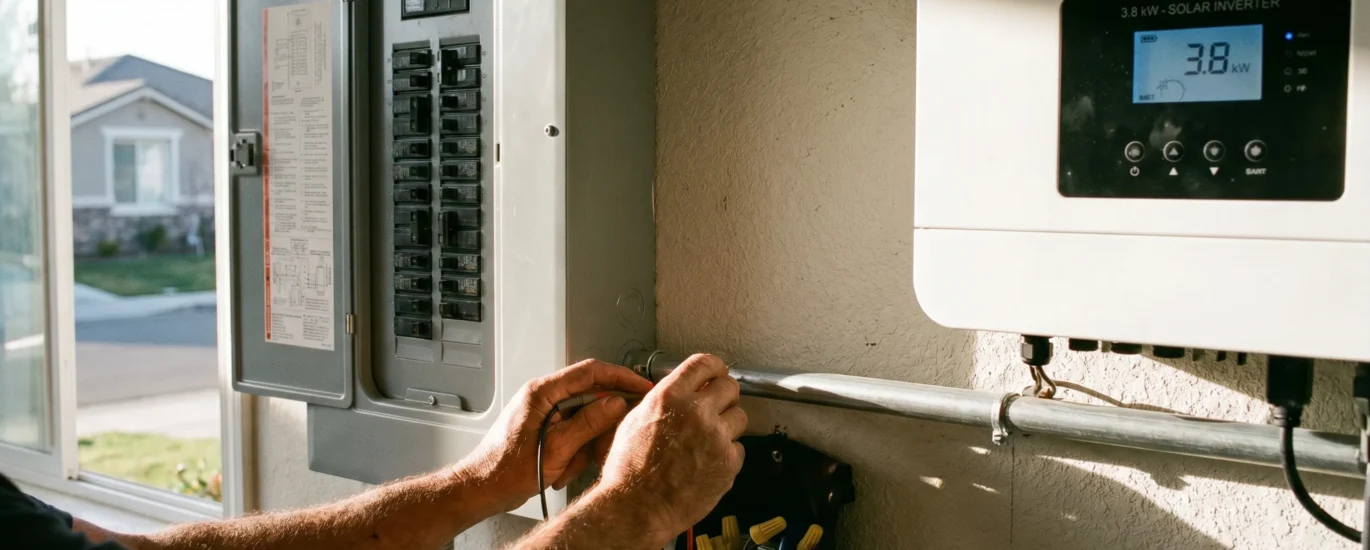
Quick Answer: Most Sacramento homes built before 1990 need a 200-amp panel upgrade before solar can be installed. SMUD requires a compatible 200-amp service for most grid-tied systems. The upgrade typically costs $2,500 to $4,500 in Sacramento, takes one day, and must be completed – and inspected – before your solar installer can pull an interconnection permit. Federal tax credits for panel upgrades expired after December 31, 2025.
If you’ve gotten a solar quote and the installer mentioned your panel, you’re not alone. Panel upgrades are one of the most common items Sacramento homeowners don’t see coming when they start the solar process. What feels like a simple add-on can delay your timeline by weeks and add thousands to a budget you thought was set.
This post covers exactly when a panel upgrade is required before solar, what it costs in the Sacramento market, how SMUD handles the interconnection side, and what the 2026 incentive landscape actually looks like after recent federal changes. If you’re planning solar for this year or next, this is the sequence that matters.
Table of Contents
Does Your Sacramento Home Actually Need a Panel Upgrade Before Going Solar?
Not every home needs an upgrade – but a large share of Sacramento’s housing stock does. The deciding factor is your current service size and available panel capacity.
Homes built before the early 1990s across Sacramento – whether in Land Park, the Pocket area, Arden-Arcade, or older parts of Citrus Heights – were frequently wired with 100-amp service. Some have been upgraded since. Many haven’t. A 100-amp panel that’s already carrying a full load of appliances, HVAC, and general circuits typically does not have room for the dedicated solar backfeed breaker a grid-tied system requires.
The practical test is available breaker space and load calculation. If your panel is full or your available capacity doesn’t support the solar system’s backfeed requirements, the upgrade is not optional – it’s a code requirement.
Here’s when an upgrade is required vs. when it may not be:
| Your Panel Situation | Upgrade Needed? |
|---|---|
| 100-amp service, pre-1990 home, limited breaker space | Yes – almost always |
| 100-amp service with available space and low load | Likely yes – SMUD recommends 200A for solar |
| 125-amp service with existing solar prep or space | Evaluate – depends on load and system size |
| 200-amp service with open breaker slots | No – ready for solar as-is |
| 200-amp service, panel full or breakers at capacity | Tandem breakers or sub-panel may be needed |
The only way to know for certain is an on-site panel assessment. Under The Sun Electric assesses panel capacity as part of every solar-prep evaluation – call (916) 899-3062 or see our electrical panel upgrade services in Sacramento for more detail on what the inspection covers.
How Much Does a Panel Upgrade for Solar Cost in Sacramento?
The cost range is wide because the variables are real – not padding. Here’s what drives price in the Sacramento market specifically.
| Scenario | Typical Cost Range |
|---|---|
| Standard 100A to 200A upgrade, existing location, open access | $2,500 – $3,500 |
| 100A to 200A upgrade with panel relocation | $3,500 – $5,000 |
| Service upgrade requiring SMUD coordination and meter work | $4,000 – $6,000+ |
| Permit fees (City of Sacramento or Sacramento County) | $50 – $200 |
What pushes cost up: panel relocation (common when the original location doesn’t meet current clearance codes), new conduit runs, a deteriorated service entrance that needs replacement at the same time, or homes where the meter and main panel are housed in the same enclosure requiring more coordination with SMUD on the disconnect sequence.
What keeps cost down: panels in accessible locations with no relocation needed, homes with newer service entrance wiring already in place, and jobs where the electrician and solar installer are coordinating the work together rather than scheduling two separate visits.
One note worth flagging: if your solar installer is quoting you the panel upgrade as part of their package, ask specifically whether a licensed C-10 electrical contractor is doing that work. Solar installation licenses (C-46) do not cover electrical panel work in California. The panel upgrade requires a separate C-10 license and its own permit. Under The Sun Electric holds CA Lic. #1141678 and handles both the panel upgrade and the solar prep wiring so you’re not managing two separate contractors and two separate permit timelines.
What Does SMUD Require for Solar Interconnection?
Sacramento is SMUD territory, and SMUD has its own interconnection requirements that are distinct from PG&E’s process. If your home is in any part of Sacramento, Rancho Cordova, Elk Grove, or the broader SMUD service area, this is the process that governs your solar install.
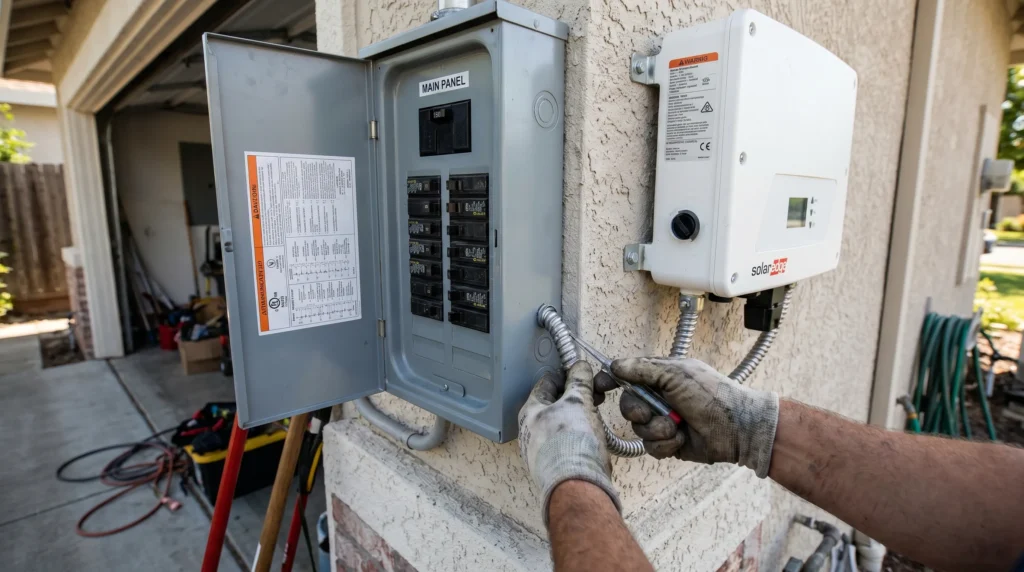
SMUD recommends a 200-amp service for most grid-tied solar systems. This is not technically a hard rule for every system in every configuration, but practically speaking, any solar installer submitting for SMUD interconnection will flag a 100-amp panel as a risk item. The interconnection application process includes a load analysis, and if available capacity doesn’t support the proposed system size, SMUD will require the upgrade before issuing permission to operate (PTO).
For new solar customers approved since March 1, 2022, SMUD places customers on the Solar and Storage Rate (SSR). Under the SSR, excess power exported to the grid earns approximately 7.4 cents per kilowatt-hour – a reduction from legacy net metering rates, but still a meaningful credit toward your monthly bill.
One important note for 2026: SMUD still has an active battery storage rebate program – up to $5,400 per Tesla Powerwall, with a household cap of $10,000 – while every other major California utility’s battery rebate programs closed at the end of 2025. If you’re considering adding storage to your solar system, the timing to act on the SMUD rebate is now, not later.
The panel upgrade must be permitted, inspected, and signed off before your solar installer can submit the interconnection application. These steps run in sequence – the panel work is not something you can do simultaneously with the solar installation. Plan for that timeline.
What Does the Panel Upgrade Process Actually Look Like?
For most Sacramento homeowners, the upgrade runs like this:
Step 1 – Panel assessment. An electrician evaluates your current panel, available capacity, service entrance condition, and physical location. This is the only way to get an accurate quote and timeline.
Step 2 – Permit application. Your electrician pulls a permit through either the City of Sacramento or Sacramento County Building Department, depending on your address. This is non-negotiable – unpermitted panel work voids your homeowner’s insurance coverage for any electrical-related claim and creates title problems when you sell.
Step 3 – SMUD coordination. For service upgrades, SMUD needs to disconnect power at the meter while the new panel is installed. Your electrician schedules this with SMUD – it typically requires a few days’ lead time. Plan for a full day without power.
Step 4 – Installation. The panel swap itself typically runs six to eight hours. Most Sacramento homeowners are back on power the same day.
Step 5 – Inspection. The city or county inspector signs off on the work. Your electrician should handle scheduling and be on-site for the inspection.
Step 6 – Solar installation proceeds. Once the panel is permitted and inspected, your solar installer can move forward and submit the SMUD interconnection application.
Total timeline from assessment to solar-ready: typically two to four weeks when permits are moving normally. Homes that skip the assessment and try to start with the solar installer end up adding weeks when the panel issue surfaces mid-process.
Our Sacramento panel upgrade team coordinates directly with your solar installer so the sequencing doesn’t create delays on your project.
What Happened to the Federal Tax Credits for Panel Upgrades and Solar?
This is the question most Sacramento homeowners asking about solar in 2026 aren’t getting a straight answer on, so here it is clearly.
The federal residential solar tax credit (25D) – previously 30% of system cost – expired for new installations after December 31, 2025. The One Big Beautiful Bill Act, signed into law July 4, 2025, ended the credit with no phase-out period. Solar systems installed in 2025 qualified. Systems installed in 2026 do not, under current law.
The 25C Energy Efficient Home Improvement Credit, which covered up to 30% of panel upgrade costs (capped at $600) when the panel enabled a qualified heat pump or heat pump water heater, also expired after December 31, 2025.
What this means practically: the federal incentive math that drove a lot of 2023-2025 solar decisions no longer applies in 2026. The SMUD Solar and Storage Rate’s export credits and the SMUD battery rebate remain, and the economics of solar in Sacramento still work – the average 10-to-11-kilowatt system can still meaningfully offset a SMUD bill – but the federal credit is no longer part of the calculation for new installations this year.
If you’re working with a solar company that is still advertising a 30% federal tax credit on 2026 installations, ask them to point you to current IRS guidance. The credit program as written has ended.
Is a Panel Upgrade Worth It if the Goal Is Just Solar?
The right answer depends on where your panel stands today and what else you’re planning for the property.
The upgrade is clearly worth it when:
- Your panel is at capacity. A full 100-amp panel is a liability even without solar. Adding solar without the upgrade isn’t possible – and your panel was eventually going to need attention anyway.
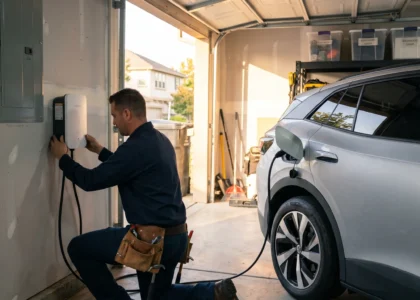
- You’re also adding EV charging. A Level 2 EV charger requires its own 50-amp circuit. If you’re installing solar and want to charge a car at home, the 200-amp upgrade makes both possible without a second round of panel work.
- You’re planning other electrification. Heat pumps, heat pump water heaters, induction ranges – all of these draw significantly more than their gas equivalents. Upgrading now sets up every future electrification project.
- You’re staying in the home long-term. A 200-amp panel, properly installed and permitted, adds value to the home and removes an objection during any future sale.
It’s worth slowing down when:
- Your solar quote is already at the edge of your budget. Adding $3,000 to $4,500 to a $15,000 solar project is a significant jump. Make sure the total number still makes sense on a payback timeline.
- You have a 200-amp panel with space. If the panel capacity is already there, don’t let anyone sell you an upgrade you don’t need. Get a second opinion from a licensed C-10 electrician before committing.
- You’re planning to move in the next two to three years. The ROI timeline for solar in Sacramento under the SSR rate is longer than it was under legacy net metering. Run the numbers before committing to a major project on a short ownership horizon.
What Should Sacramento Homeowners Do Before Getting a Solar Quote?
Getting the panel assessment done first – before you sign a solar contract – puts you in a much stronger position. Here’s the sequence that avoids the surprises:
- Pull your SMUD bill and note your annual kWh usage. This tells the solar installer what system size you actually need. Oversizing a system under the SSR rate doesn’t earn you proportionally more – the export credit is capped.
- Have a licensed electrician assess your panel before the solar company does. Solar installers assess panels too, but they’re motivated to move the project forward. An independent electrician’s assessment gives you an unbiased picture of what the panel work will cost and whether it’s actually required.
- Confirm license types. Your solar installer needs a C-46. Whoever does the panel work needs a C-10. These are separate licenses for a reason – verify both.
- Ask about SMUD interconnection lead times. SMUD’s interconnection queue for new solar applications has run four to eight weeks in some recent periods. This is part of your total project timeline, not something that happens after installation.
- Get the permit timeline in writing. Sacramento County and the City of Sacramento have different permit windows. Know which jurisdiction your address falls under and what the current turnaround looks like before you plan around an install date.
Bottom Line – What Sacramento Homeowners Going Solar Need to Know in 2026
The panel upgrade question is not a surprise if you plan for it. Most pre-1990 homes in Sacramento will need to move from 100-amp to 200-amp service before a solar install can proceed. The work costs $2,500 to $4,500 in most cases, takes one day, and runs in sequence – not parallel – with the solar installation itself.
The federal tax credit window that drove 2023-2025 solar decisions has closed. The SMUD Solar and Storage Rate’s export credits and battery rebate still make the economics work, but the math is different than it was eighteen months ago. Go in with current numbers, not last year’s assumptions.
Under The Sun Electric handles panel assessments, 200-amp upgrades, and solar-prep wiring across Sacramento and the surrounding area. If you’ve got a solar quote and a panel question, we can give you a straight answer before you commit to anything.
Call or Text: (916) 899-3062
Learn more about our Sacramento solar services | See our panel upgrade services