In the SMUD vs PG&E comparison, the utility on your meter changes what a panel upgrade, solar array, or EV charger actually costs. SMUD customers pay about $149 a month at 750 kWh and get 9.6 cents per kWh for solar exports. PG&E customers pay about $290 and fall under NEM 3.0. Roseville Electric runs its own rules entirely.
Most homeowners never think about which utility serves them until they price out a project. Then it matters a lot. SMUD vs PG&E is the comparison people search for, but around here it is really a three-way split. We work across a service area covered by three separate electric utilities, and the same 200-amp panel upgrade, the same solar array, and the same Level 2 charger can carry very different numbers depending on which side of a boundary line the house sits on. This post covers who serves which city, how the rebates differ, why NEM 3.0 only applies to one of the three, and what all of that means for your project budget.
Who Actually Provides Your Electricity in the Sacramento Area?
Three utilities cover the cities we serve, and they do not follow county lines the way people expect.
| City | Electric utility | Regulated by CPUC? |
|---|---|---|
| Sacramento | SMUD | No |
| Elk Grove | SMUD | No |
| Citrus Heights | SMUD | No |
| Rancho Cordova | SMUD | No |
| Roseville | Roseville Electric Utility | No |
| Folsom | PG&E | Yes |
| Rocklin | PG&E | Yes |
| Lincoln | PG&E | Yes |
Folsom surprises people. It sits inside Sacramento County, but the city is PG&E territory, not SMUD. A homeowner in Folsom and a homeowner five miles west in Rancho Cordova are on two different rate structures, two different rebate programs, and two different sets of solar rules. When we quote a job in Folsom, the utility question comes up before anything else.
That CPUC column is the one that drives most of the difference. SMUD is a community-owned district and Roseville Electric is a city department. Neither answers to the California Public Utilities Commission. PG&E is an investor-owned utility and does. Every statewide solar rule you have read about in the news applies to PG&E customers and stops at the SMUD and Roseville boundaries.
SMUD vs PG&E vs Roseville Electric: How Much Do Rates Actually Differ?
SMUD publishes a monthly comparison of average residential bills across California utilities. As of June 1, 2026, a household using 750 kWh per month pays roughly:
| Utility | Average monthly bill at 750 kWh |
|---|---|
| SMUD | $149 |
| Roseville Electric | $156 |
| PG&E | $290 |
PG&E lists its average bundled residential rate at 39.25 cents per kWh as of March 2026. SMUD says its rates run more than 50 percent below its neighboring investor-owned utility.
That gap changes the math on almost every project we quote. A Folsom homeowner adding an EV and a heat pump is looking at a much larger monthly increase than a Citrus Heights homeowner adding the same equipment. It also means solar pays back faster in Folsom, because every kWh you avoid buying is worth roughly twice as much there. And it means SMUD customers who want solar are usually chasing something other than a fast payback, which we will get to.
Does NEM 3.0 Apply to SMUD or Roseville Electric Customers?
No. NEM 3.0, now called the Solar Billing Plan, is a CPUC decision. It governs PG&E, Southern California Edison, and SDG&E. SMUD and Roseville Electric set their own solar compensation through their own governing bodies.
Here is what each one actually pays for exported solar power.
PG&E customers in Folsom, Rocklin, and Lincoln
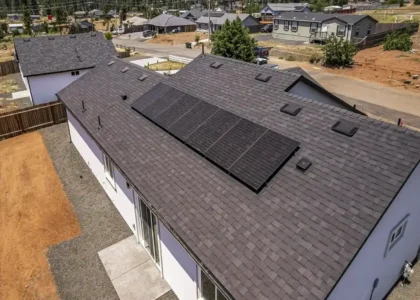
Under NEM 3.0, exports are compensated at avoided cost, which lands roughly in the 4 to 8 cent per kWh range and swings with time of day and season. That is down from near-retail credit under the old NEM 2.0. Anyone in Folsom pricing solar today should assume the exported power is worth a fraction of the power they buy, which is why battery storage has gone from optional to close to mandatory for a PG&E solar project to make sense.
SMUD customers in Sacramento, Elk Grove, Citrus Heights, and Rancho Cordova
SMUD runs its Solar and Storage Rate for anyone approved to install solar or storage on or after March 1, 2022. Effective June 1, 2026, SMUD pays 9.6 cents per kWh for exported power, flat, regardless of time of day or season. That went up from 7.4 cents. Customers approved before March 1, 2022 can stay on the older NEM rate through December 31, 2030, unless they move, replace the system, or add battery storage with SMUD incentives.
A flat rate is simpler to plan around than a seasonal avoided-cost schedule. The tradeoff is that SMUD’s retail rates are already low, so the savings per kWh you offset are smaller.
Roseville Electric customers
Roseville runs Roseville Solar 2.0, which took effect October 1, 2018 once local solar passed 5 percent of system peak. New systems get a surplus energy compensation rate of 6.91 cents per kWh. Customers who interconnected before October 2018 keep the old NEM rate until October 1, 2028 or 20 years from interconnection, whichever comes later. One detail catches people: if you expand an existing Roseville system by 10 percent or more, you lose the grandfathered NEM rate and move to Solar 2.0. Adding four panels to an old array can quietly cost you the better rate on the whole system.
SMUD has a parallel rule. Increase generating capacity by more than 10 percent or 1 kW, whichever is greater, and you move to the Solar and Storage Rate and file a new interconnection application. If you are thinking about expanding an older array, run those numbers before anyone climbs on the roof. Our solar installation team checks the interconnection date on every expansion quote for exactly this reason.
What EV Charger Rebates Does Each Utility Offer?
This is where the three utilities diverge the most, and where a lot of outdated advice is still floating around.
| Program detail | SMUD | PG&E | Roseville Electric |
|---|---|---|---|
| Level 2 charger rebate | Up to $250 | Up to $500, income-qualified | $200 per charger |
| Dedicated circuit rebate | Up to $500 | Up to $2,000 panel upgrade, income-qualified | None |
| Circuit sharing or load management device | Up to $200 | Not a standalone rebate | None |
| Program cap | $600 combined, one per address for life | Varies by program | One per household per calendar year |
| Application window | Per program terms | Standard rebate applications due Aug 31, 2026 | Postmarked within 90 days of purchase |
SMUD’s Charge@Home program is the most generous for a typical middle-income household because it is not income-gated. The full $600 is available to any SMUD residential customer, once per address, ever. Use it on the wrong project and it is gone.
PG&E’s Empower EV program is richer on paper. It covers a free Level 2 charger valued at $500 plus up to $2,000 toward a panel upgrade for a single-family home. The catch is the income test, which requires household income within 400 percent of the federal poverty level, and automatic enrollment on the EV2-A time-of-use rate for at least six billing cycles. For a Folsom household that qualifies, it is the best deal of the three by a wide margin.
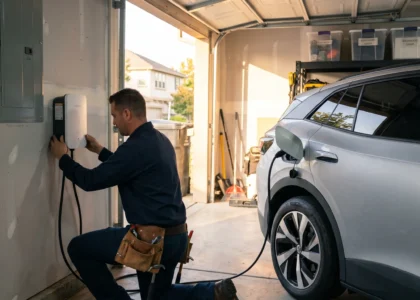
Roseville’s $200 Level 2 rebate has real hardware requirements. The charger has to be new, UL or ETL listed, wall or pedestal mounted, rated at least 32 amps, and carry a cable of at least 15 feet. We have seen homeowners buy a 24-amp unit on sale and lose the rebate over it. The application also has to be postmarked within 90 days of purchase, which is a shorter fuse than most utility programs.
One thing changed for everyone. The federal 30C tax credit, which paid 30 percent of a residential charger installation up to $1,000, expired June 30, 2026 under the One Big Beautiful Bill Act. The IRS test was placed in service, not purchased or scheduled. Installations finished after that date get nothing federal. If you were quoted a price last spring that assumed the credit, that quote is stale. Our EV charger installation estimates reflect current program amounts only.
Does Your Utility Change What a Panel Upgrade Costs?
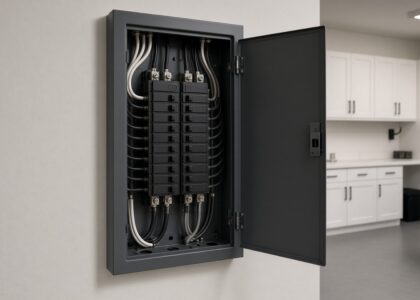
The electrical work itself is largely the same. A 200-amp service upgrade involves the same panel, the same feeders, the same grounding and bonding, and the same NEC requirements no matter who owns the pole. What changes is the coordination around it, and coordination is where schedules slip.
Every utility has to disconnect and reconnect service at the meter. Every one of them has its own application, its own approval queue, and its own inspection sign-off before power comes back. SMUD in particular has specific equipment and location standards, and on older Sacramento homes we regularly find a meter and panel arrangement that no longer meets them. That turns a straight swap into a relocation.
Permits are the other variable, and they follow the city, not the utility. Roseville projects go through the City of Roseville Building Division at 916-774-5332. Folsom projects go through the City of Folsom. Citrus Heights, Rancho Cordova, and Elk Grove each run their own building departments, and unincorporated Sacramento County parcels go through the county. Two houses a mile apart can sit under different building departments with different plan review queues.
Older homes bring a third variable. A lot of the housing stock we work on in Sacramento and Citrus Heights was built between the 1950s and 1970s with 60 or 100 amp service, and a fair amount of it has prior work that was never permitted. Added sub-panels, a garage circuit somebody’s uncle ran, an addition wired without inspection. That surfaces at resale or during a utility inspection, and it usually has to be corrected before the new service is energized. We handle retroactive permitting on panel upgrades in Sacramento and panel upgrades in Roseville often enough that we build it into the quote up front.
Worth knowing: SMUD points out that a Level 2 charger does not always require a panel upgrade. A circuit sharing device lets an EV charger and an electric dryer split one circuit, and an energy management device throttles the charger to protect the main breaker. SMUD pays up to $200 toward either. On a 100-amp panel with a manageable load, that can save thousands. We will tell you when that is the better answer.
What Does Each Utility Pay for Battery Storage?
SMUD has the most aggressive battery program of the three. My Energy Optimizer Partner+ pays a one-time enrollment incentive of $500 per kWh minus a 20 percent holdback, capped at $10,000 per household. A single Tesla Powerwall at 13.5 kWh earns $5,400. A 10 kWh Enphase IQ Battery earns $4,000. You have to enroll within 90 days of receiving permission to operate, and you have to be on the Solar and Storage Rate. Tesla owners also collect quarterly payments of $110 for one battery, $220 for two, $330 for three or more.
The 90-day window is the part people miss. Miss it and the incentive is gone, no appeal. We flag the PTO date on every SMUD storage job we do.
PG&E customers do not have an equivalent utility program, though the statewide SGIP incentive is available. For Folsom, Rocklin, and Lincoln homeowners the case for a battery rests on different ground: NEM 3.0 export rates are low enough that storing your own power and using it during the 4 to 9 p.m. peak beats selling it back, and the foothill wildfire and public safety power shutoff risk makes backup worth something on its own.
What Should You Ask Before Hiring an Electrician for This Work?
- Ask which utility serves the address and whether the quote reflects that utility’s current rebate amounts. Program numbers changed in 2026.
- Ask who files the utility application and who pulls the permit. If the answer is you, keep shopping.
- Verify the license. California’s CSLB lets you look up any contractor at cslb.ca.gov. Under the Sun holds a C-10 electrical contractor license and carries insurance.
- Ask what happens if the inspector finds unpermitted prior work. A real answer beats a cheap number.
- For solar, ask for the interconnection date on any existing system before agreeing to an expansion.
- Ask whether a circuit sharing device would do the job instead of a full panel upgrade.
Bottom Line: Which Utility You Have Should Change How You Plan the Project
If you are on PG&E in Folsom, Rocklin, or Lincoln, solar with storage is the strongest play you have, because your retail rate is roughly double SMUD’s and your export credit is low. Size the system around covering your own usage. The export credit is a rounding error at those rates.
If you are on SMUD, the battery incentive is the standout. Up to $10,000 for enrolling in My Energy Optimizer Partner+ is money no other local utility matches, and the 90-day enrollment clock after PTO is the deadline that matters most.
If you are in Roseville, check your solar interconnection date before you expand anything, and buy an EV charger that meets the 32-amp and 15-foot cable spec so the $200 rebate actually lands.
We work in all three territories, we file the utility paperwork and pull the permits ourselves, and we handle the electrical, solar, and EV side of a project without you coordinating three companies. If you want a straight answer on what your utility means for your project, request a free estimate from Under the Sun Solar & Electric, or call us at 916-899-3062. We serve Sacramento, Roseville, Rocklin, Folsom, Elk Grove, Lincoln, Citrus Heights, and Rancho Cordova.