Quick Answer: Most Sacramento homeowners pay about $800-$1,500 for a permitted Level 2 EV charger install on a ready panel, or $1,500-$2,500+ when the run is long or the panel is tight. Level 1 is often $0-$300. Panel upgrades, when needed, commonly add $1,500-$3,500+. SMUD Charge@Home and the federal 30C credit can cut the net cost when you qualify.
If you searched ev charger installation cost sacramento, you want real local ranges, not a national average. Below we break down Level 1 vs Level 2 vs DC Fast, what moves price on Sacramento panels, and which rebates still apply. When you are ready for a site visit, use our EV charger installation service in Sacramento.
How much does EV charger installation cost in Sacramento?
These ranges match what we already publish for Sacramento jobs. They reflect local labor, typical permit fees, and the panel stock we see on estimates – not a generic U.S. average.
| Setup | Typical Sacramento range | Notes |
|---|---|---|
| Level 1 (120V outlet) | $0-$300+ | Cord set often included with the car; new dedicated outlet often $150-$300 |
| Level 2 straightforward | $800-$1,500 | Ready 200A panel, short garage run, standard wall connector |
| Level 2 complex | $1,500-$2,500+ | Long conduit, outdoor pedestal, panel near capacity |
| Panel upgrade add-on | $1,500-$3,500+ | Common on 100A services before a 40-50A EV circuit |
| DC Fast (commercial) | $15,000-$50,000+ | Not a home product; 480V three-phase |
Inside a Level 2 quote you usually see hardware around $300-$800+, electrician labor around $400-$900+, City of Sacramento or county permit fees around $50-$300+, and conduit or wiring materials around $100-$400+. Your written estimate should list those lines so the total is not a mystery.
What is the difference between Level 1, Level 2, and DC Fast charging?
Level 1 uses a standard 120V outlet and adds roughly 3-5 miles of range per hour. Full charges on a large battery can take a day or more. It works for many plug-in hybrids and short-commute drivers who park overnight every night.
Level 2 uses a dedicated 240V circuit – the same voltage class as a dryer – and adds about 25-40 miles per hour. Most battery EVs go from low to full overnight. This is the install Sacramento homeowners usually mean when they ask about home charging cost.
DC Fast charging (sometimes called Level 3) is the public 480V class you see along I-80 and at Supercharger sites. It is not a residential product. If a quote waves around DC Fast for a driveway, walk away.
| Level | Voltage | Miles per hour (typical) | Home install? |
|---|---|---|---|
| Level 1 | 120V | 3-5 | Yes |
| Level 2 | 240V | 25-40 | Yes, licensed electrician |
| DC Fast | 480V+ | 180-240 | No – commercial/public |
What factors change EV charger cost in Sacramento homes?
The charger unit is rarely the whole story. The panel and the wire path are.
Panel capacity. Many central Sacramento homes built from the 1950s through the 1980s still have 100-amp service. Adding a 40- or 50-amp EV breaker to a full panel is not always safe without an upgrade. We see that pattern on jobs in Land Park, Curtis Park, and older East Sacramento stock. Newer areas such as Natomas, Elk Grove, Folsom, and Roseville more often start with 200-amp panels and a simpler Level 2 path.
Permit jurisdiction. City of Sacramento requires a permit for most Level 2 installs. Sacramento County and Placer County also require permits for their addresses. Budget roughly $50-$300 for typical residential EV permit fees unless your city posts a different schedule.
Utility territory. Most City of Sacramento addresses are SMUD. Roseville is Roseville Electric. Some edges of the region are PG&E. Rebate rules follow the meter, not the city name on your mail.
Run length and mounting. A panel on the opposite side of the house from the parking spot means more conduit, more labor, and sometimes an outdoor-rated pedestal. Sacramento heat and UV also push us toward outdoor-rated EVSE and UV-resistant conduit when the unit sits in direct sun.
We pull permits as part of the job. California Government Code Section 65850.7 streamlines many EV charger approvals compared with a generic electrical permit, but you still need the inspection.
Which rebates and tax credits can lower your Sacramento install cost?
Stack only what you qualify for. Program details change – confirm on the utility site and with your tax advisor before you count on a number.
| Incentive | Amount on our live guide | Who it fits |
|---|---|---|
| SMUD Charge@Home | Up to $600 | SMUD residential customers (charger, devices, and install pieces as SMUD defines) |
| Roseville Electric Utility | $200 | REU residential Level 2 installs |
| Federal 30C credit (Form 8911) | Up to $1,000 (30% of qualified costs) | Eligible census tracts; live guide notes property placed in service after June 30, 2026 may miss this credit |
On a straightforward $1,000-$1,200 Level 2 job, SMUD plus a qualifying federal credit can drop net cost sharply – sometimes to a few hundred dollars out of pocket when both apply. Income-qualified SMUD EAPR customers should ask SMUD whether a free charger path still exists for their rate.
Some rebates want pre-approval or a utility-listed contractor. Ask during the estimate so paperwork is not an afterthought.
When is Level 2 worth it, and when is Level 1 enough?
Choose Level 2 when you drive a full battery EV, when daily miles regularly beat what an overnight Level 1 top-off can replace, or when you want to finish charging inside SMUD’s off-peak window. Our live guide cites SMUD’s 1.5 cents/kWh credit for charging between midnight and 6am – verify the current schedule on smud.org before you plan around it.
Level 1 can be enough for many PHEVs with small packs, for drivers under roughly 25-30 miles a day who plug in every night, or for a short-term rental where a hardwired unit does not pay back.
Do not “save money” by sharing a Level 1 cord on a crowded garage circuit with a fridge and shop tools. A dedicated, code-correct outlet is the cheap safety fix.
Do you need a panel upgrade before an EV charger?
Not always. A load calculation decides it. If the panel has spare capacity and a free breaker space for the EV circuit, a Level 2 install can stay in the $800-$1,500 band. If the panel is maxed, fused, or still 100 amps with modern kitchen and HVAC loads, upgrading first is the honest path.
A panel upgrade commonly adds $1,500-$3,500+ on Sacramento jobs, and it also clears room for solar or battery work later. For a deeper panel cost walkthrough, see our electrical panel upgrade cost in Sacramento post, and the companion question post Does an EV charger require a panel upgrade?.
What should you look for in a Sacramento EV charger installer?
Hire a licensed C-10 electrician, not a handyman with a wall connector in the truck. You can verify Under the Sun Electric as CSLB #1141678 on the CSLB site. Ask whether the bid includes permit fees, inspection, and a load calculation in writing.
Prefer outdoor-rated hardware when the unit sits in sun. Right-size amperage – a 32-amp circuit is enough for most overnight home charging; a 48-amp unit is often more than you need. Universal J1772 (or Tesla Wall Connector with the adapter path you actually use) beats locking yourself to one car forever.
Unpermitted installs show up in home inspections and can create insurance problems after an electrical fire. Permitted work protects the sale and the policy.
How do you keep EV charger costs under control?
- Get the panel assessed before you buy the most expensive EVSE on the shelf.
- Mount on an interior garage wall when you can. Pedestals and long exterior runs cost more.
- Apply for SMUD or Roseville rebates in the order the utility requires.
- If you need the federal 30C credit, confirm census-tract rules and the June 30, 2026 placed-in-service cutoff with your tax advisor.
- Bundle only the electrical work you need now. Solar and battery can share a future panel plan without forcing every dollar into day one.
What does a typical Sacramento EV charger install day look like?
Most Level 2 jobs follow the same sequence. We confirm panel ampacity and breaker space, mark the charger location, and agree on the conduit path before tools come out. If the City of Sacramento or the county needs a permit, that packet goes in before rough work starts.
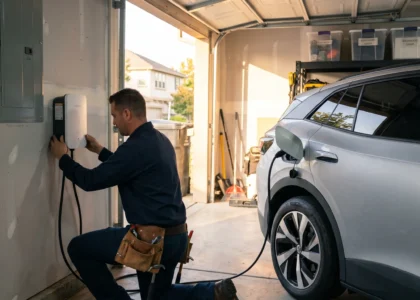
On install day we kill the affected circuits, land the new breaker, pull wire, mount the EVSE, and torque terminations to the manufacturer spec. Then we energize, run a test charge if you have the vehicle on site, and leave the inspection sticker path clear for the city inspector. You get photos of the panel schedule and the final wall layout.
Straightforward garage installs often finish in a single day once permits clear. Panel upgrades add a second phase: utility coordination, temporary power planning when needed, and a separate inspection. That is why a cheap “charger only” bid that ignores the panel creates change orders later.
Which charger brands work on Sacramento homes?
We install Tesla Wall Connector units and universal J1772 Level 2 stations. Many owners want one hardwired unit that will still work if they change cars in three years. Adapters exist; we still size the circuit for the continuous load the manufacturer lists, not for marketing peak numbers on the box.
Smart chargers with load management help on older 100-amp services when a full panel upgrade is not in the budget yet. Those devices throttle charging when the home already draws hard. They are not a substitute for a dangerous panel, but they can keep a borderline load calc honest. Ask for that option on the estimate if you are trying to stage costs.
Skip no-name imported EVSE with missing UL listing. Sacramento inspectors and insurers both care about listed equipment on a permitted circuit.
How does Sacramento permitting affect timeline and price?
Permit fees themselves are usually the smaller line on the quote – often in the $50-$300 band for a residential Level 2 job. Time is the part owners feel. City of Sacramento EV charger permits are often faster than a full service upgrade because of the state streamlining rules, but you still wait for issuance and for an inspection slot.
County addresses follow Sacramento County or Placer County calendars. We schedule rough and final around those windows so the charger is not left unenergized longer than needed. If your HOA requires an architectural application, that is your document trail – we can supply cut sheets and a one-line scope letter, but we do not invent HOA rules that were never sent to us.
Rush work that skips the permit to “save a week” is how unpermitted chargers show up in real estate disclosures. Budget the fee and the inspection day into the project from the start.
Bottom Line
If your Sacramento panel is ready, budget about $800-$1,500 for a permitted Level 2 install. If the panel needs work, add $1,500-$3,500+ and treat that as infrastructure, not a surprise fee. Level 1 stays a low-cost path only when your daily miles and battery size fit a 120V overnight charge. Stack SMUD or Roseville rebates and a qualifying federal credit when you can, then book a crew that pulls the permit.
Ready for a number on your garage? Start with our EV charger installation service page, or call 916-899-3062. Mon-Fri 8am-6pm; Saturday by appointment; Sunday closed. Free on-site estimate.
Sources (plain text): Under the Sun Electric live cost guide on this URL (published ranges retained for this rewrite); SMUD Charge@Home program pages at smud.org; Roseville Electric Utility residential EV charger rebate materials; IRS Alternative Fuel Vehicle Refueling Property Credit (Section 30C) / Form 8911 notes including the live guide’s June 30, 2026 placed-in-service caveat; California Government Code Section 65850.7 (EV charger permit streamlining).